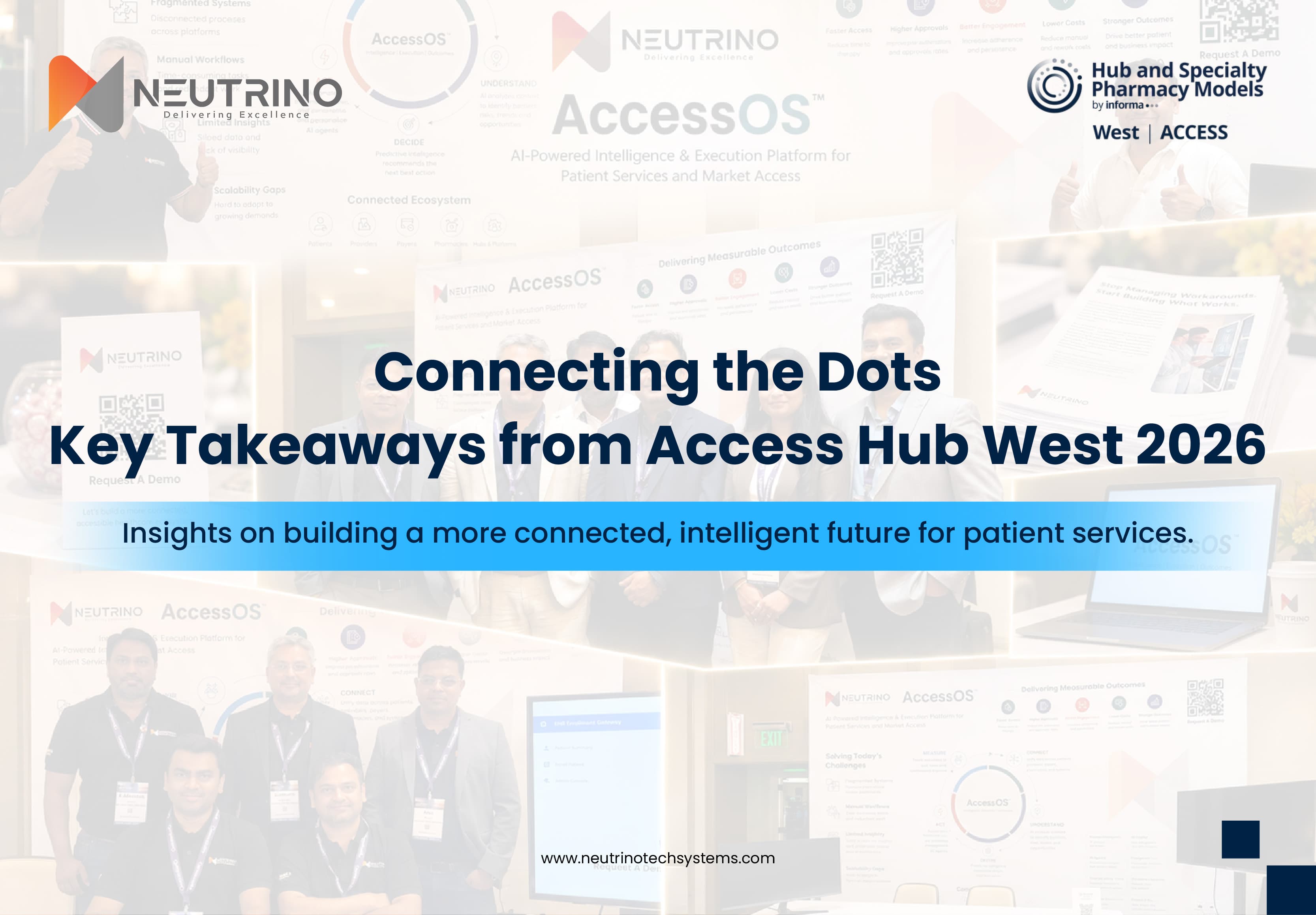
Three days of conversations, perspectives, and challenging questions at Access Hub & Specialty Pharmacy Models West 2026 left us with one strong impression: patient access is ready for its next evolution.
In San Diego, conversations around patient services, specialty pharmacy, market access, AI, and automation went beyond what technology can do. They focused on something more fundamental: how technology can work better together to solve real challenges across the patient journey.
And perhaps that was the biggest takeaway of all. The opportunity is not simply to add more technology, but to connect the people, processes, data, and intelligence that make patient access possible.
Here are the insights we're taking forward from Access Hub & Specialty Pharmacy Models West.
The Real Opportunity Lies Between the Silos
A patient's path to therapy can involve multiple teams, systems, and handoffs, from hub services and specialty pharmacy to field reimbursement and market access. Yet these functions often operate independently, leaving teams to bridge the gaps themselves.
The conversations at Access Hub & Specialty Pharmacy Models West made the impact of this fragmentation hard to overlook. When systems and workflows do not connect, complexity builds, visibility gets harder, and valuable time is lost.
The takeaway? A more seamless patient experience starts behind the scenes, with a more connected ecosystem supporting it.
Technology Should Start With the Problem, Not the Promise
It can be easy to get caught up in what new technology can do. The more important question is where it can make a meaningful difference.
That means understanding where teams lose time, where decisions slow down and where patients encounter unnecessary friction before deciding where technology fits in. AI and automation are powerful tools, but their value depends on how well they address the realities of the workflow.
The goal should not be another tool or another login. It should be a smarter way of working that delivers measurable value for teams and, ultimately, for patients.
AI Needs to Move Closer to the Work
AI was naturally part of many conversations at Access Hub & Specialty Pharmacy Models West. What stood out, however, was the shift from talking about AI as a possibility to asking where it can create real outcomes.
When intelligence is embedded into the workflows teams already use, it can help simplify complex decisions, surface relevant information faster and reduce repetitive work. Automation can extend that value by taking routine processes off teams' plates and helping organizations scale more sustainably.
The opportunity is not to put AI beside the workflow, but to bring it into the workflow.
Connecting the Pieces Changes What Is Possible
Another theme emerged from the conversations: the industry is beginning to look beyond individual point solutions and toward a more connected operating model.
Hub intelligence, market access, specialty pharmacy and other patient services all contribute to the same patient journey. Bringing these functions closer together through connected workflows and a shared view of the patient can create a very different way of operating.
This is the thinking behind AccessOS, Neutrino's approach to bringing AI, automation and interoperability into the Salesforce workflows teams already use. Rather than adding another destination, the aim is to make intelligence part of the work itself, helping teams operate with greater visibility, consistency and scale.
The Future of Patient Access Is About Rethinking the Journey
If Access Hub & Specialty Pharmacy Models West 2026 reinforced anything for us, it is that the next phase of patient services will not be defined by how much technology is added, but by how thoughtfully it is connected.
The opportunity ahead is to move beyond fragmented processes and rethink the patient journey around connected data, intelligent workflows, and meaningful outcomes. Less friction for patients. Greater clarity for teams. More scalable operations for organizations.
We're grateful to everyone who stopped by our booth, shared their experiences, challenged our thinking, and made time for meaningful conversations throughout the event. Thank you for being part of the conversation. We look forward to continuing it and exploring what we can build together for the future of patient access.