
7 AI Trends in Healthcare Addressing Burnout, Trust, and Adoption
AI trends in healthcare are approaching a pivotal moment in 2026, marked less by experimentation and more by real-world execution and accountability. Intelligence is increasingly embedded within everyday clinical and operational workflows, often operating quietly but delivering measurable impact. A Recent industry research indicates that over 70 percent of healthcare organizations globally are now implementing or scaling AI initiatives, signaling a clear shift from curiosity to commitment.
What is changing is not just the technology itself, but where and how it is applied. This moment calls for a grounded view that looks beyond predictions and buzzwords to examine what is actually taking shape inside healthcare systems today.
The following 7 AI trends in healthcare highlight the most meaningful shifts defining how care delivery, clinical decision-making, and healthcare operations will evolve through 2026. These AI healthcare trends are not about replacing clinicians, they are about redesigning how care flows.
1. AI Embedded Within Everyday Healthcare Workflows
For years, AI in healthcare lived on the sidelines as separate dashboards, alerts, and tools clinicians had to actively check. That model is quickly fading. In 2026, AI is increasingly embedded directly into electronic health records, care coordination platforms, and core systems that clinicians already use every day.
Instead of pulling users away from their workflow, intelligence now surfaces at the exact moment decisions are made, documentation is created, or care is handed off. The real transformation happens when AI works quietly within the flow of care, reducing friction rather than adding to it. From a technology standpoint, this shift favors workflow-native AI and robust integration architectures over standalone models, making system design more important than algorithm complexity.
2. Generative AI Transforming Clinical Documentation and Knowledge Flow
Clinical documentation has long been one of the most time-intensive and fragmented aspects of care delivery. Among the most impactful AI trends in healthcare today is the use of generative AI to support how clinical knowledge is captured, structured, and shared. Its role now extends far beyond note-taking, helping summarize longitudinal patient histories, structure discharge instructions, and support clearer clinical handoffs across teams.
The real value lies not in speed, but in preserving clinical context as information moves between systems and caregivers. From a technology standpoint, this trend underscores the importance of domain-grounded language models, robust guardrails, and human-in-the-loop design to ensure accuracy and trust in real clinical environments.
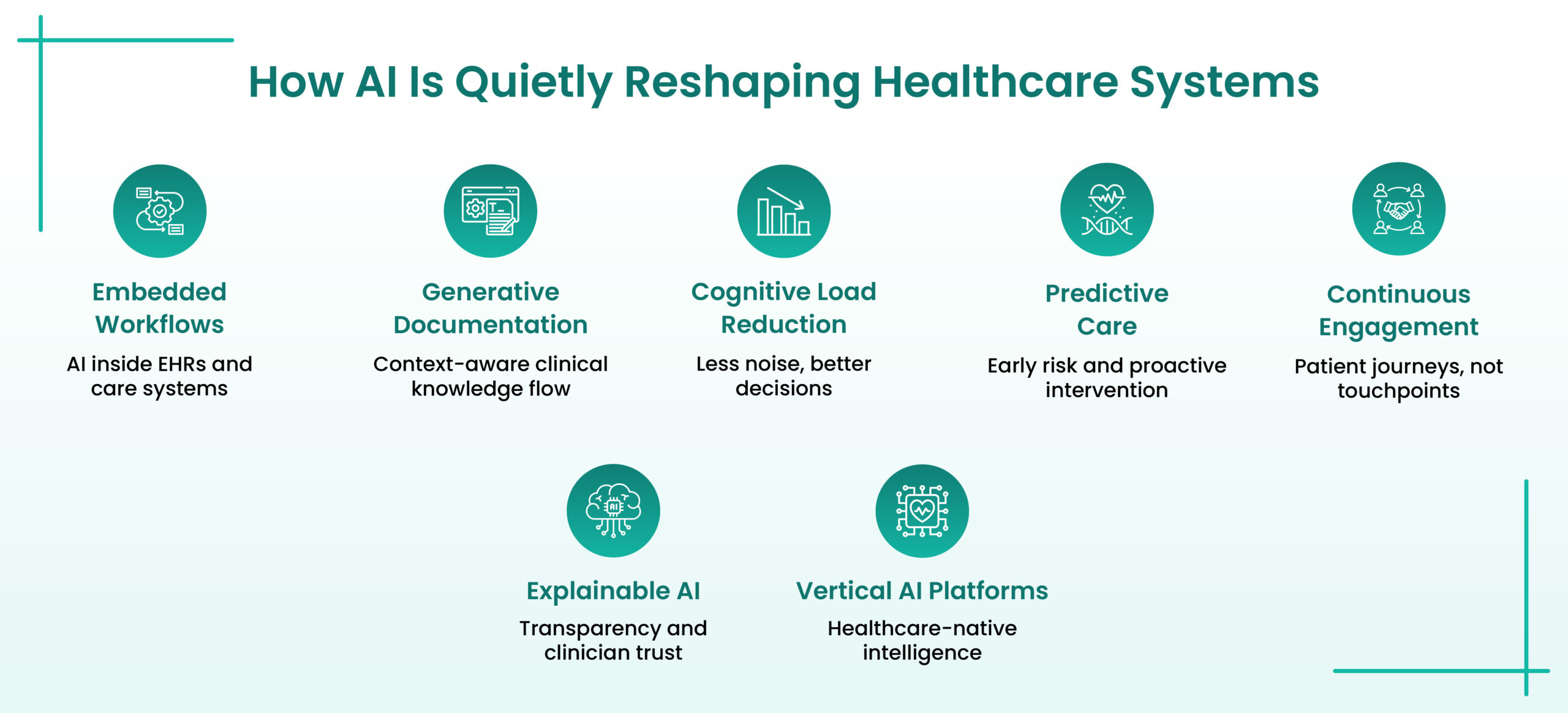
3. Designing Systems That Reduce Cognitive Load
Healthcare systems rarely suffer from a lack of data. The real challenge is filtering the signal from the noise. One of the most meaningful AI trends in healthcare is the shift toward systems designed to reduce cognitive load rather than simply increase speed or automation.
AI is increasingly used to prioritize clinically relevant information, suppress non-critical alerts, and surface insights only when they are needed most. This approach directly addresses clinician burnout by reducing constant interruptions and decision fatigue. From a technology perspective, effectiveness depends on signal prioritization, context awareness, and intelligent decision support that adapts to clinical scenarios instead of overwhelming users with more data.
4. Predictive Intelligence Enabling Proactive Care
Among the most impactful AI trends in healthcare is the growing use of predictive intelligence to move care from reactive response to proactive intervention. Predictive models are increasingly applied to identify early risk signals, prevent avoidable readmissions, and surface care gaps before they escalate.
However, accuracy alone does not determine impact. The true value of predictive AI depends on when and where insights appear within clinical workflows. A well-timed, well-integrated signal can change outcomes, while an isolated prediction often goes unused. From a technology standpoint, this makes longitudinal data pipelines and tight workflow integration essential. Predictive insights must reach the right clinician at the right moment to meaningfully influence care decisions.
5. Patient Engagement That Extends Beyond Appointments
One of the more visible AI trends in healthcare is how patient engagement is evolving from isolated interactions into a continuous, care-driven experience. Rather than relying solely on reminders or chatbots, AI is now supporting personalized education, proactive follow-ups, and communication that adapts to each stage of the patient journey. This shift matters because engagement is increasingly seen as a clinical continuity tool rather than a marketing layer.
When patients receive timely, relevant information that aligns with their care plan, outcomes improve. From a technology perspective, conversational AI must integrate seamlessly with clinical systems, while contextual personalization plays a critical role in driving sustained adoption and trust.
6. Explainability as a Foundation for Trust
Black-box AI struggles to survive in clinical environments where decisions must be understood, justified, and trusted. As AI trends in healthcare continue to mature, explainability is becoming a non-negotiable requirement rather than a nice-to-have feature. Healthcare organizations are increasingly demanding transparency, auditability, and clarity around how AI-driven recommendations are generated.
This shift is being accelerated by regulatory expectations, liability concerns, and the need for clinician confidence in AI-assisted decisions. From a technology perspective, interpretability must be designed into models from the outset rather than added later. Equally important, thoughtful UX design plays a critical role in making complex outputs understandable and usable in real-world clinical settings.
7. The Shift Toward Vertical, Healthcare-Specific Platforms
Generic AI tools often struggle to meet the demands of regulated, high-stakes healthcare environments. As AI trends in healthcare continue to evolve, there is a clear shift toward vertical platforms built specifically for clinical and operational realities. These platforms are designed with domain-specific models, healthcare-native data standards, and compliance-aware architectures from the ground up.
The result is faster deployment, fewer integration hurdles, and greater confidence among users. From a technology standpoint, vertical AI accelerates real-world adoption by aligning intelligence with how healthcare actually operates. Domain fluency not only improves outcomes, but also builds the trust required for AI systems to be used consistently and effectively.
Wrapping Up: What These AI Trends in Healthcare Mean for Leaders
The most impactful AI trends in healthcare are not the loudest or the most visible. They are the ones quietly embedded into systems, workflows, and everyday decisions, shaping care without disrupting it. For healthcare leaders, this means prioritizing integration over experimentation, workflows over standalone tools, and adoption over novelty.
For a broader, cross-industry perspective on how AI is maturing beyond pilots, Neutrino’s Tech Newsletter NextByte Edition 12: The AI Maturity Moment: Top 10 Trends Defining 2026 offers valuable context on this shift. This philosophy shapes how Neutrino builds scalable, healthcare-ready AI architectures that work within complex clinical and operational ecosystems. When intelligence is engineered to fit naturally into systems already in use, the future of healthcare AI will not feel disruptive, it will feel inevitable.