
From Black Box to Bedside: Why Explainable AI Oncology Matters in Real Care

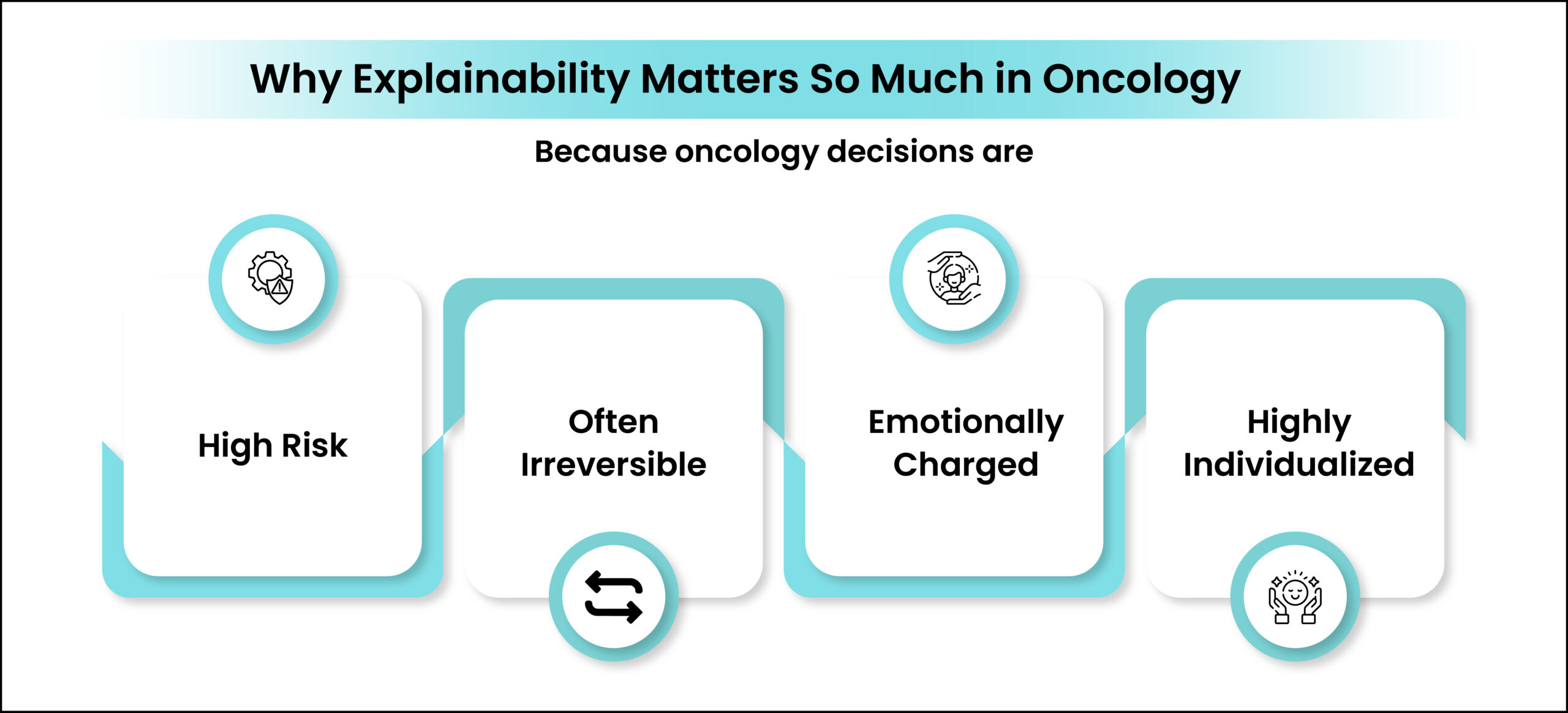
A single recommendation can change the course of a cancer patient journey. It can shape hope, uncertainty, and the decisions patients and clinicians carry forward together. Yet despite rapid advances in artificial intelligence, trust remains fragile. Research shows that more than 60 percent of clinicians cite a lack of explainability as a primary barrier to adopting AI in high-risk clinical workflows. In oncology, where decisions are deeply personal and often irreversible, this hesitation is well founded.
Choices are rarely incremental. They define treatment courses, influence long-term outcomes, and carry consequences that extend far beyond a single consultation. As artificial intelligence moves closer to these moments of influence, its role shifts from silent analysis to a clinical voice shaping care pathways. This is why explainable AI oncology, often referred to as XAI in healthcare, is no longer optional. When technology begins to guide treatment decisions, it must be understood, questioned, and trusted by everyone involved in the care journey.
The Core Problem: Why Black-Box Systems Fail Without Explainable AI Oncology
Recently, it has been calculated that many AI models used in oncology demonstrate impressive accuracy across diagnostics, risk prediction, and treatment planning. However, high performance alone rarely translates into clinical confidence. In tumor boards, where decisions are debated, challenged, and refined, recommendations that cannot be explained often stall rather than accelerate action. Clinicians need to understand not only what an AI system predicts, but the clinical reasoning behind it in order to evaluate relevance, risk, and applicability to individual patients.
This gap becomes even more pronounced under regulatory scrutiny. Clinical decision support systems are expected to offer traceability, auditability, and defensible logic, especially in high-risk specialties like oncology. A prediction without context is difficult to validate and even harder to scale responsibly.
Patients add another layer of accountability. As AI begins to influence care pathways, transparency becomes central to trust. When explanations are missing, confidence erodes across the entire care ecosystem, reinforcing why explainable AI oncology is critical to meaningful adoption.
Interpretable Models: Designing Explainable AI Oncology That Clinicians Can Reason With
Not all explainability is created equal. Many AI systems rely on post-hoc explanations layered on top of complex models, offering simplified rationales after a prediction is made. While helpful, these approaches can feel disconnected from clinical reasoning. In contrast, inherently interpretable models are designed with transparency at their core, allowing clinicians to see how inputs influence outcomes as part of the decision process itself.
In explainable AI oncology, interpretability becomes most effective when model signals align with familiar clinical variables. Feature attribution tied to biomarkers, disease staging, imaging patterns, and longitudinal patient data allows oncologists to assess relevance using the same mental frameworks they already trust. Confidence scoring and uncertainty ranges further support informed decision-making, reinforcing clinical judgment rather than replacing it. When AI logic reflects how oncologists evaluate evidence, explainability becomes intuitive, actionable, and clinically meaningful.
UX Patterns That Make Explainable AI Oncology Understandable at the Point of Care
In oncology settings, usability is not a design preference, it is a clinical requirement. Even when models are interpretable, poorly designed interfaces can overwhelm clinicians and obscure meaning at the moment decisions are made. Explainable AI oncology succeeds only when insights are delivered in a way that aligns with real clinical workflows and time constraints.
Effective systems rely on UX patterns that organize complexity rather than flatten it:
- Progressive disclosure that surfaces high-level insights first, with deeper context available on demand.
- Visual timelines that connect patient history, diagnostics, and disease progression directly to AI-driven predictions.
- Side-by-side views that compare clinical judgment with and without AI support, reinforcing trust through contrast.
- Clear separation between recommendations, supporting rationale, and associated risk factors to preserve clinical autonomy.
When designed well, UX does not simplify oncology. It structures complexity into something clinicians can reason with and act upon confidently.
Communicating Explainable AI Oncology Insights to Patients Without Creating Fear or Confusion
For patients, AI can feel abstract, intimidating, or even impersonal, especially when it enters conversations about cancer care. The way insights are communicated often matters as much as the insights themselves. Explainable AI oncology plays a critical role in supporting shared decision-making by translating complex outputs into narratives patients can understand without feeling overwhelmed.
This begins with framing AI as a support system rather than an authority. Plain-language summaries, visual aids, and contextual explanations help patients see how AI contributes to their care while keeping human judgment at the center. When clinicians walk patients through what influenced a recommendation and what uncertainties remain, confidence increases. Reinforcing clinician oversight at every step ensures that technology enhances trust rather than eroding it.
Platform-Level Explainability: Embedding Explainable AI Oncology Into the System Architecture
Explainability cannot be treated as a surface-level feature added after models are deployed. In high-stakes domains like oncology, trust is shaped by how consistently transparency is maintained across the entire system. Explainable AI oncology requires architectural decisions that embed clarity from data ingestion through model execution to user interaction.
This includes traceable data pipelines, model outputs that retain context, and interfaces designed to expose reasoning without overwhelming users. Robust audit trails support clinical review, regulatory compliance, and internal governance, ensuring decisions can be examined long after they are made. Continuous monitoring adds another layer of accountability by detecting model drift and explaining how predictions evolve as data changes.
Explainable AI Oncology in 2026: What Trust-First Systems Look Like Today
It is just the beginning of 2026, and explainability is no longer being discussed as a future requirement in oncology AI. It is the baseline. Explainable AI oncology platforms now adapt explanations to the person in front of the screen, offering clinical depth for oncologists, operational clarity for care teams, and accessible context for patients. As patient data evolves, explanations evolve with it, updating rationale and confidence levels in real time rather than locking decisions into static outputs.
Regulatory expectations around transparency have matured, pushing platforms to demonstrate traceability by design rather than by exception. At the same time, trust has become a measurable signal of success, reflected in clinician adoption, sustained usage, and confidence at the point of care. In today’s oncology landscape, systems earn value not by calculating faster, but by communicating better.
Closing Thoughts on Explainable AI Oncology
As oncology AI continues to mature, one principle stands out. Explainability is foundational to adoption, not an accessory added for reassurance. Systems succeed when their reasoning aligns with how clinicians evaluate evidence, question assumptions, and make high-stakes decisions. Model accuracy opens the conversation, but thoughtful UX, interpretability, and workflow integration sustain long-term use.
Trust extends beyond clinicians. Patient understanding and communication play a decisive role in acceptance, especially when AI influences care decisions. Platforms that scale responsibly are those that embed explainability into architecture, governance, and experience from the start.
This is the approach taken by Neutrino Tech Systems, where AI and innovation are applied with deep healthcare context. By focusing on explainable, human-centered systems, Neutrino works to ensure intelligence earns confidence at every step of the oncology journey.