
Patient 360 in Healthcare: From Data Fragmentation to Proactive Care

Healthcare generates enormous volumes of patient data across electronic health records, pharmacy systems, insurance claims, and connected devices. Yet much of this information remains dispersed across disconnected platforms, making it difficult for care teams to see the complete patient journey. This growing complexity has brought Patient 360 in healthcare into focus as an approach centered on creating a unified, longitudinal view of patient data across the entire care ecosystem, enabling more coordinated, informed, and proactive care.
Despite widespread digital adoption, fragmentation persists. In fact, research shows nearly 96% of U.S. hospitals use electronic health records, yet critical patient data often remains siloed across systems. Building a true Patient 360 view, therefore, requires more than integration; it demands robust data engineering capable of connecting, structuring, and activating healthcare data at scale.
Why Patient 360 in Healthcare Remains Difficult to Achieve
Healthcare organizations operate within one of the most complex data environments of any industry. Over decades, hospitals, payers, pharmacies, and digital health providers have implemented specialized systems designed for functions such as clinical documentation, billing, pharmacy management, and patient engagement. While these platforms improved efficiency within individual domains, they were rarely built to communicate seamlessly with one another.
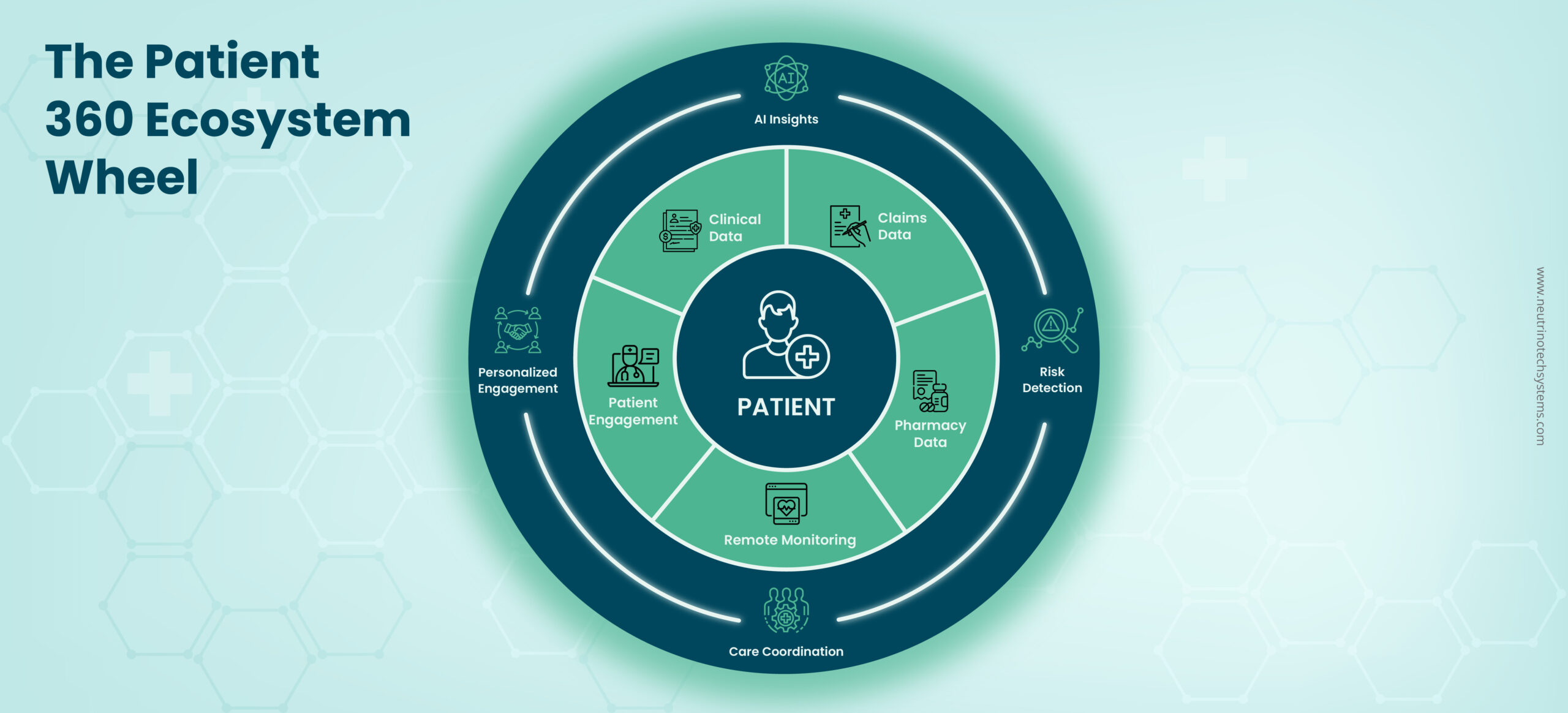
As a result, critical information remains distributed across clinical records, claims data, pharmacy systems, remote monitoring devices, and patient engagement platforms. Differences in data formats, coding standards, and patient identifiers further complicate integration. Healthcare organizations, therefore, do not suffer from a lack of data. The real challenge is creating the unified context required to enable Patient 360 in healthcare
What a True Patient 360 Data Architecture Looks Like
Building Patient 360 in healthcare requires more than simply connecting systems. It calls for a data architecture designed to integrate diverse sources, standardize information, and create a reliable foundation for patient insights. At the center of this architecture is a unified patient identity, often supported by a master patient index that helps reconcile records and accurately match patient data across different systems.
Equally important are interoperable data pipelines that enable both real-time and batch data ingestion while normalizing information from multiple platforms. These pipelines bring together signals from sources such as EHR systems, claims platforms, specialty pharmacy systems, remote monitoring devices, and patient-reported outcomes. Strong governance layers, including data quality management, privacy controls, and regulatory compliance, ensure that this unified data remains accurate and trustworthy, enabling a longitudinal patient record that evolves with every stage of the care journey.
The Role of Data Engineering in Enabling Patient 360
Achieving Patient 360 in healthcare depends on a strong engineering foundation that can unify, structure, and activate patient data at scale. Data engineering makes it possible to move beyond fragmented records and build systems that continuously integrate and interpret patient signals across the care ecosystem. Key capabilities that support this transformation include:
- Scalable healthcare data platforms that leverage cloud native architectures to process and manage diverse healthcare datasets
- Advanced data modeling that structures patient journeys in ways that support clinical insights, analytics, and care coordination
- Real-time healthcare intelligence that enables continuous monitoring and timely insights rather than relying on static records
- AI-ready data infrastructure that prepares healthcare data environments for machine learning and predictive care models
Together, these capabilities enable healthcare organizations to transform raw data into actionable intelligence. Building Patient 360 systems, therefore, requires engineering first thinking, not just analytics dashboards layered on fragmented data.
Turning Unified Data Into Intelligent Care
When patient data is unified and structured effectively, healthcare organizations can begin to unlock meaningful clinical and operational insights. A comprehensive patient view enables care teams to move from reactive treatment toward more proactive and personalized care delivery. With the right data foundations in place, healthcare systems can identify risks earlier, detect gaps in care, and engage patients in more targeted ways.
For example, unified patient records can support early risk detection for individuals managing chronic conditions, allowing interventions before complications escalate. They can also help identify missed screenings or treatment gaps while enabling personalized patient engagement based on health history and behavior patterns. At the same time, a shared patient view improves coordination across providers, ensuring that clinicians, care teams, and specialists operate with the same context. In this way, a unified patient record becomes the foundation for more intelligent, AI-driven healthcare systems.
Accelerating Patient 360 with AI-Powered Platforms
While many healthcare organizations recognize the value of Patient 360 in healthcare, turning fragmented data into real operational intelligence remains a significant challenge. Organizations often struggle to build patient intelligence layers that unify clinical, administrative, and financial information while also making these insights usable across care teams.
Neutrino’s CareIQ, an AI-powered patient 360 platform, addresses this gap by enabling a unified, real-time view of patient health across the healthcare ecosystem. The platform connects patients, clinicians, hospital staff, insurers, and administrators within a secure environment, bringing together patient management, appointments, clinical documentation, medications, lab results, insurance, and billing data into a single system. By combining dynamic dashboards, AI-driven insights, and integrated workflows, CareIQ helps healthcare teams monitor patient journeys more effectively, improve care coordination, and support proactive interventions at scale.
Connect with us to know more about our AI accelerator: https://calendly.com/nts
Wrapping Up
Healthcare is steadily moving beyond static records toward continuous patient visibility, where real-time signals from clinical systems, devices, and digital health platforms provide a more complete understanding of patient needs. As these ecosystems evolve, AI-powered care orchestration will play a critical role in translating patient data into timely interventions, coordinated care pathways, and more personalized engagement. This shift also underscores the growing importance of strong data engineering foundations that can integrate diverse sources and activate insights at scale.
At Neutrino, we see Patient 360 in healthcare as more than a technology capability. It is a step toward building healthcare systems that are designed around the patient rather than around fragmented systems. By combining AI-driven engineering with platforms that unify and operationalize healthcare data, we aim to help organizations move from simply storing patient records to enabling intelligent, connected care experiences.