
Specialty Pharmacy Prior Authorization and the Growing Disconnect in Patient Access

Specialty therapies are advancing at an unprecedented pace, reshaping treatment across oncology, autoimmune disorders, and rare diseases. Yet while healthcare innovation continues to accelerate, patient access remains trapped within fragmented administrative systems. The growing burden of specialty pharmacy prior authorization is causing treatment delays driven by disconnected workflows, repeated documentation, and inefficient approval processes.
And the impact is becoming impossible to ignore. According to the American Medical Association (AMA), 94% of physicians report that prior authorization delays patient access to necessary care, while nearly one-third say these delays have led to serious adverse events for patients. As specialty drug utilization continues to rise, healthcare organizations are being forced to rethink how patient access, reimbursement, and prior authorization workflows are managed across the specialty pharmacy ecosystem.
The Hidden Divide Behind Specialty Pharmacy Workflows
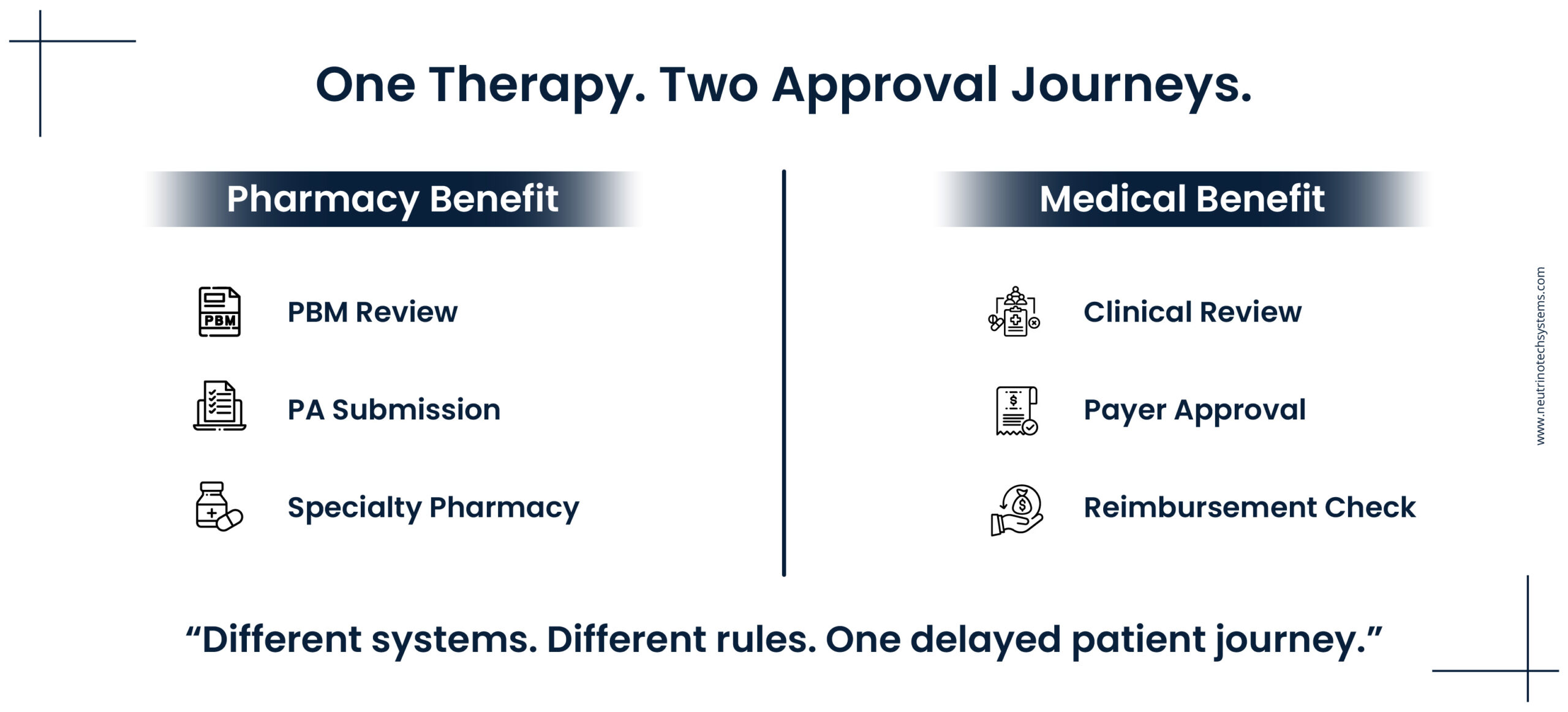
One of the biggest challenges in specialty pharmacy prior authorization today is the disconnect between pharmacy benefit and medical benefit workflows. While both pathways ultimately support patient treatment, they often function through entirely separate authorization systems, reimbursement structures, and payer requirements. For providers, this creates a fragmented process that involves managing duplicate documentation, navigating multiple approval pathways, and coordinating manually across disconnected stakeholders.
The challenge becomes even more complex with high-cost specialty medications, where authorization criteria frequently differ across payers and benefit structures. As a result, healthcare teams are forced to spend valuable time tracking approvals, responding to documentation requests, and managing delays that slow therapy initiation. What was originally designed as a utilization management process has increasingly become an operational barrier to timely patient access.
The Cost of Delays Extends Beyond Administration
The impact of fragmented specialty pharmacy prior authorization workflows extends far beyond operational inefficiencies. It creates a growing administrative pressure that consumes clinical time and strains already overloaded teams for the providers.
Staff members are often required to manage repeated follow-ups, appeals, status tracking, and payer communication for a single therapy request, slowing down both care delivery and reimbursement cycles. For patients, these delays can directly affect treatment initiation and continuity of care. Specialty therapies are often prescribed for complex or progressive conditions where timing plays a critical role in outcomes. When approvals are delayed, patients may experience interruptions in therapy, reduced adherence, or uncertainty throughout the care journey.
As specialty drug utilization continues to rise, the challenge is no longer simply about managing approvals more efficiently. It is about ensuring that operational complexity does not become a barrier to patient access itself.
Why the Industry Can No Longer Ignore This Problem
The reality is that patients do not experience healthcare in silos. They do not see pharmacy benefits, medical benefits, payer workflows, or authorization pathways. They simply experience delays in getting the treatment they were prescribed.
That is why the conversation around specialty pharmacy prior authorization is beginning to shift. Healthcare organizations are increasingly realizing that manual workflows, disconnected systems, and fragmented communication are no longer sustainable in a specialty-driven healthcare environment. As specialty therapies become more complex and more widely used, the pressure to create faster, more connected access pathways is only growing stronger.
The focus is no longer just on processing approvals. It is to reduce the friction that stands between patients and timely care.
Bridging the Gap Between Innovation and Access
Specialty therapies are advancing faster than ever, but innovation alone cannot improve outcomes if patients struggle to access treatment in time. Addressing the growing challenges around specialty pharmacy prior authorization will require more than isolated automation efforts or faster approvals. It will require a more connected approach to patient access that brings providers, payers, specialty pharmacies, and support services into a more unified ecosystem.
In many cases, the biggest obstacle to timely treatment is no longer the therapy itself, but the fragmented process patients must navigate to receive it.
The Future of Specialty Pharmacy Depends on Connected Access
As specialty drug utilization continues to grow, healthcare organizations will need to rethink how access is managed across the care journey. Faster approvals alone will not solve the larger challenge if providers, payers, and specialty pharmacies continue operating through disconnected systems and workflows.
Improving specialty pharmacy prior authorization requires greater visibility, stronger interoperability, and a more coordinated approach to patient access. Organizations that can simplify these workflows and reduce administrative friction will be better positioned to improve treatment timelines, patient experience, and long-term care outcomes in an increasingly specialty-driven healthcare landscape.
Where Do We Go From Here
Stepping back from the conversations at Asembia 2026, a clear direction begins to take shape. The future of patient access will not be defined by isolated innovation or incremental fixes.
What is emerging instead is a more connected approach. One that brings together ecosystems that communicate seamlessly, automation that is intelligent and purposeful, and a deeper understanding of the patient journey as a whole.
For us at Neutrino, these conversations reinforced something we have long believed. Real progress in patient access comes from pairing technology with context and approaching innovation with clear intent.
Wrapping Up
The future of specialty care will not be defined only by the therapies entering the market, but by how efficiently patients can access them. As healthcare systems continue to navigate rising specialty drug utilization, the conversation around specialty pharmacy prior authorization is shifting from administrative efficiency to patient impact. Reducing delays, eliminating fragmented workflows, and creating more connected access pathways will be critical to ensuring that innovation translates into timely and meaningful care for the patients who need it most.
Neutrino partners with healthcare organizations to reduce administrative complexity, improve workflow coordination, and accelerate patient access across specialty pharmacy operations.