
Tech Newsletter
Enterprise AI,
But Built for the Real World
How modern AI architectures are enabling enterprise systems to connect with real data, tools, and workflows.
Tech contributor
Pratiksha Bande
About
AI Architecture · RAG and MCP
Read time
~6 minutes
About The Write-up
As organizations accelerate their adoption of AI, the challenge is no longer experimentation but building systems that can work reliably with real enterprise data. In this edition of NextByte, we explore the architectures enabling this shift from Retrieval-Augmented Generation (RAG) to Model Context Protocol (MCP). This edition looks at how modern AI systems retrieve knowledge, interact with enterprise tools, and support real operational workflows, helping organizations move from isolated AI experiments to scalable, context-aware enterprise intelligence.
Introduction: The Architecture Powering Enterprise AI
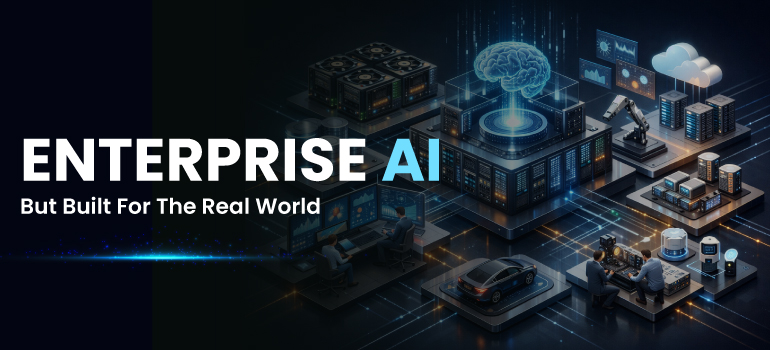
Artificial Intelligence is no longer confined to research labs or experimental prototypes. It is rapidly becoming part of the operational backbone of modern organizations. In fact, recent global studies show that nearly 78% of companies now use AI in at least one business function, reflecting how quickly AI has moved from experimentation to enterprise adoption.
From automating complex processes to enabling faster, data-driven decisions, AI is beginning to reshape how businesses operate. Yet building enterprise AI that truly delivers value is far more complex than simply connecting a Large Language Model to an application. For AI to function effectively in real enterprise environments, it must be able to access organizational knowledge, interact with internal systems, and operate within secure and governed frameworks.
This is where modern AI architectures come into focus. Approaches such as Retrieval-Augmented Generation (RAG) and Model Context Protocol (MCP) are enabling AI systems to move beyond isolated intelligence toward something far more powerful systems that can understand context, retrieve relevant information, and work seamlessly within real business workflows.
The Enterprise AI Reality Check
Why LLMs Alone Are Not Enough
Large Language Models are powerful, but they have an important limitation. They primarily rely on the data they were trained on. This means they often lack access to critical enterprise information such as real-time operational data, internal documentation, structured databases, and proprietary knowledge systems.
Without access to this information, AI systems risk generating incomplete or inaccurate responses. For enterprise environments where accuracy, compliance, and trust are essential, this limitation becomes a significant challenge.
To address this gap, modern enterprise AI architectures must enable models to dynamically retrieve and process relevant data from internal systems.
Retrieval-Augmented Generation
Giving AI Access to Enterprise Knowledge
Retrieval-Augmented Generation (RAG) is an architectural approach that enhances AI systems by allowing them to retrieve information from external sources before generating responses.
Instead of relying solely on the model’s internal knowledge, the system first gathers relevant information from enterprise data sources such as internal databases, document repositories, knowledge management systems, and enterprise APIs.
This retrieved information is then provided as context to the language model, enabling it to generate responses grounded in accurate and up-to-date data.
Inside the RAG Engine
How Context-Aware AI Systems Work
A typical RAG pipeline follows a structured process:
- A user submits a query to the AI system.
- The system converts the query into embeddings, which are numerical representations of text.
- A vector database retrieves relevant documents using similarity search.
- The retrieved context is passed to the language model.
- The model generates a response based on this contextual information.
This architecture significantly improves the reliability of AI systems by ensuring responses are grounded in real data rather than assumptions.
Why Enterprises Are Adopting RAG
Organizations are increasingly adopting RAG architectures because they address some of the most critical challenges in enterprise AI. RAG helps reduce hallucinations in AI responses, improves the accuracy of generated outputs, and enables natural language access to internal systems.
For example, an employee could simply ask:
“Show the patient records added this week.”
The AI system retrieves relevant information from internal databases and provides a summarized response, making complex systems easier to interact with.
Beyond Chatbots
The Rise of AI Agents That Can Take Action
Traditional AI chatbots are designed primarily to answer questions.
Modern AI systems, however, are evolving into AI agents capable of performing multi-step tasks and interacting with enterprise tools.
AI agents can retrieve information from multiple systems, interact with APIs, execute workflows, and automate repetitive processes.
Instead of just generating answers, they can actively assist with operational tasks such as generating reports, retrieving analytics data, or supporting day-to-day workflows.
But enabling AI systems to interact with enterprise tools introduces a new challenge: how to standardize communication between AI models and external systems.
Model Context Protocol (MCP)
The Missing Layer for Enterprise AI Integration
As AI systems become more deeply integrated into enterprise environments, they must interact with multiple tools including databases, APIs, document repositories, and analytics platforms.
The Model Context Protocol (MCP) is emerging as a framework that standardizes how AI models communicate with external tools and services.
Instead of building custom integrations for every system, MCP provides a structured interface that allows AI models to access tools and retrieve contextual information dynamically.
This simplifies development while enabling more powerful and scalable AI architectures.
Four Capabilities Transforming Enterprise AI
MCP introduces several important advantages for enterprise AI systems.
Standardized Integration
AI models can interact with enterprise tools through a consistent protocol, reducing integration complexity.
Improved Context Awareness
AI systems can retrieve information from multiple sources to generate more relevant and accurate responses.
Security and Governance
Organizations can define strict rules about what data or systems AI models can access.
Scalable Architecture
New tools and services can be integrated without rebuilding the entire system architecture.
Together, these capabilities make MCP a critical building block for enterprise-grade AI systems.
Where These Technologies Are Already Making an Impact
Real Enterprise Applications
These technologies are not just theoretical concepts. They are already being applied to solve real operational challenges.
One emerging use case involves AI assistants that allow users to query enterprise databases using natural language. Instead of manually navigating complex database structures, users can ask questions such as retrieving patient encounter details, viewing recent insurance claim records, or summarizing newly added data.
Using RAG-based architectures, the system retrieves the relevant information and generates contextual responses, simplifying how users interact with complex data environments.
AI in Document Intelligence
Making Sense of Medical and Clinical Data
AI systems are also transforming how organizations process large volumes of structured and unstructured documents.
These systems can assist in analyzing medical reports, diagnostic summaries, and clinical documentation. By combining language models with document processing techniques, AI can extract key insights and help professionals review reports faster and more efficiently.
This capability is particularly valuable in healthcare environments where timely access to information can significantly impact outcomes.
The Next Phase of Enterprise AI
Context-Aware, Secure, and Scalable
Artificial Intelligence is rapidly transitioning from experimental tools to core enterprise infrastructure.
Technologies such as Generative AI, Retrieval-Augmented Generation, AI agents, and Model Context Protocol are enabling organizations to build intelligent systems that interact directly with real-world data and operational workflows.
The future of enterprise AI will be defined by systems that are not only intelligent, but also secure, context-aware, and deeply integrated with enterprise environments.
Organizations that successfully adopt these architectures will be better positioned to unlock the full potential of AI and drive meaningful innovation across their operations.
Key Takeaways
Enterprise AI Needs Real Data
Models must access live enterprise knowledge sources.
RAG Reduces AI Hallucinations
Retrieves verified data before generating AI responses.
AI Agents Enable Actionable Workflows
Agents automate tasks across enterprise tools and systems.
MCP Standardizes AI Tool Integration
Creates a consistent interface between models and systems.
Context-Aware AI Drives Enterprise Value
Integrated architectures unlock reliable and scalable AI.