
The data Crisis Undermining AI in Clinical Trials (and How to Fix It)
AI in clinical trials is advancing at breakneck speed, yet a hard truth remains: most healthcare systems aren’t architecturally ready for it. While healthcare systems continue to invest in LLMs, generative AI, and predictive analytics, most organisations are discovering that innovation alone is not enough. Research shows that nearly 80 percent of medical data in the U.S. is unstructured and largely unusable for advanced analytics or AI-driven insights, as much of it resides in free-text notes, imaging outputs, and other non-standard formats.
Despite the promise, more than half of AI initiatives in hospitals struggle to progress beyond early pilots, not because the algorithms fall short, but because fragmented data environments, interoperability gaps, and legacy systems limit the ability to train, validate, and scale AI effectively. The message is becoming clear: the future of clinical AI won’t be shaped by model sophistication, but by the strength of the data backbone supporting it.
The Harsh Reality: Healthcare Data Is Still a Mess for AI in Clinical Trials
For AI in clinical trials to function reliably, healthcare data must move in a unified flow, yet the reality is very different. EHRs, EMRs, eClinical platforms, LIS and RIS systems, PACS, claims data, sensor streams, RPM feeds, and HIE inputs all sit in disconnected silos. This fragmented environment makes it difficult for AI in clinical trials to build consistent, high-quality patient profiles.
Broken Interoperability
Even where data is available, it often fails to integrate. HL7 and FHIR standards are inconsistently implemented across vendors, APIs are limited, and many organisations still depend on outdated on-premise systems. A typical health system may rely on more than ten separate clinical software tools with minimal visibility between them. These gaps directly limit how effectively AI in clinical trials can access, process, and validate critical information.
The Rise of Sensor, Wearable and Home Monitoring Data
Remote monitoring devices, IoT sensors, and app-based vitals are generating unprecedented streams of patient data. However, less than ten percent of this information is integrated into clinical workflows today. Time series data often arrives without sufficient clinical context, which reduces its usability for AI in clinical trials and restricts the model’s ability to detect meaningful patterns.
AI models cannot reach their full potential when they are trained on fragmented, outdated or inaccessible data. Strengthening data quality and flow is essential for AI in clinical trials to deliver the accuracy and trust that clinical environments require.
Why Fragmented Data Cripples Clinical AI in Trials
AI in clinical trials depends on complete, timely and well-connected patient information, yet most healthcare environments still operate with scattered, inconsistent data. When medication histories are missing, vitals are incomplete or timelines are stored across unlinked systems, AI models begin to lose context.
This weak foundation leads to inaccurate predictions and biased outputs that can directly influence clinical decisions. In real workflows, even small inconsistencies create noticeable failures. A sepsis detection model may miss a critical window if lab results arrive late, and triage algorithms can break down when EHR timestamps do not align. These disruptions erode clinician trust and make it difficult for AI in clinical trials to scale within high-stakes care environments.
Regulatory and operational challenges add further pressure. AI systems are expected to provide clear traceability, yet fragmented data makes provenance and audit trails difficult to establish. Model performance also declines over time when training data flows through disconnected pipelines.
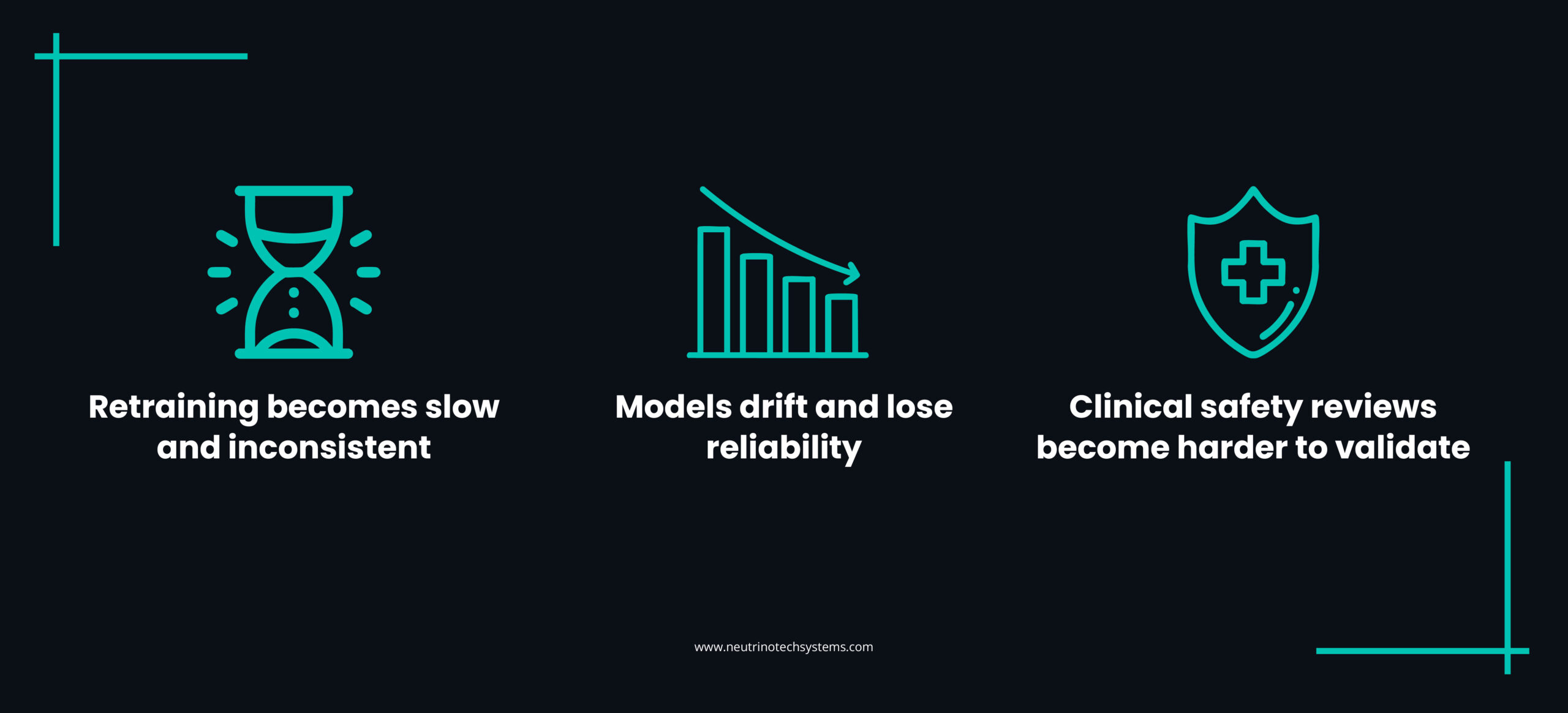
Ultimately, the biggest barrier to successful AI in clinical trials is not the sophistication of the algorithms but the fractured data ecosystem surrounding them.
The Shift: AI Is Moving From Model-First to Data-Backbone-First
Healthcare organizations are beginning to recognize that meaningful AI performance starts with strong data foundations, not complex algorithms. The focus has shifted toward improving data quality through normalization, governance, lineage and seamless integration long before any model is introduced.
Modern, cloud-native healthcare data fabrics are becoming the backbone for this transformation, enabling data to flow consistently across systems. Leading health systems are also investing in unified longitudinal patient records, giving AI the complete, real-time context it needs to deliver accurate and actionable insights.
What a Strong Data and Integration Backbone Looks Like
A robust data backbone gives AI in clinical trials the clarity, consistency and context it needs to operate safely in clinical environments. It begins with unified, vendor-neutral data ingestion where standards like HL7, FHIR, CCD, X12, DICOM and IoT streams are treated as equal, high-quality sources. Real-time data pipelines ensure that vitals, telemetry and monitoring signals flow continuously and without delay.
The backbone also relies on advanced data normalization and mapping so that SNOMED, LOINC, ICD and CPT terminology aligns across systems. De-duplication and reconciliation create clean longitudinal records, while context engines enrich patient timelines with labs, medications, sensor data and visit histories to help AI in clinical trials interpret patterns with accuracy and reliability.
Governance and privacy complete the foundation, with lineage tracking, audit-ready trails and consent-based access ensuring that every data point remains transparent, compliant and secure.
Where Neutrino Fits In: The Integration Stack That Powers Next-Gen Clinical AI
Neutrino delivers the data strength modern Clinical AI depends on. As a HealthTech IT solutions organization, we build the unified infrastructure that makes AI in clinical trials accurate, scalable and ready for real-world deployment. Our integration stack connects every layer of the healthcare ecosystem and transforms fragmented data into a reliable, AI-ready foundation.
Our core capabilities include:
- AI-powered data integration and automation that streamline complex clinical workflows
• Interoperability accelerators across FHIR, HL7 and EDI for seamless system-to-system communication
• Real-time ingestion of sensor and IoT data to enable continuous clinical visibility
• A unified clinical data platform that harmonizes information from EHRs, eClinical platforms and payer systems
• Custom-built AI pipelines including HCC coding, predictive analytics, documentation support and workflow automation
• Plug-and-play integration with leading healthcare systems to ensure rapid, low-friction deployment
Real-World Use Cases Enabled by Strong Data Backbones
A solid data foundation unlocks high-impact Clinical AI applications across care settings. It enables:
• Predictive hospital operations for bed demand and discharge planning
• Disease progression modeling across oncology, cardiology and chronic care
• Automated coding and documentation including HCC and CDI workflows
• Remote monitoring with AI triage through RPM and EHR-integrated alerts
• Population health intelligence driven by complete longitudinal records
Strong integration turns each of these into scalable, ROI-driven outcomes for healthcare organizations.
Wrapping Up
The path forward for AI in clinical trials is clear: success will belong to the organizations that treat data as their most powerful asset. As healthcare systems continue to adopt advanced models and automation, it is the integrity, flow and context of the underlying data that will ultimately determine clinical impact.
Strong data foundations create trustworthy insights, safer decisions and AI that can finally scale beyond pilots. The future of Clinical AI will not be defined by who builds the most sophisticated algorithms, but by who builds the strongest, most connected data backbone to support them.